

"Before RSMF, it was a complete nightmare,” said Scott Huter, Avalon’s Regional Director of Enterprise Sales, about exporting data from mobile devices, Slack, and other non-traditional platforms prior to Relativity’s revolutionary solution. “Clients were looking at spreadsheets, trying to hyperlink to pictures and attachments, and trying to produce all or some of it. This type of data just didn’t play nice in the eDiscovery world.”
A “short message” is just what you’d imagine: a brief communication shared by a person with another person or people via an application that allows users to converse. Short messages are difficult to process in eDiscovery as there is no one native format shared by the various platforms, which makes exporting and reviewing difficult.
Enter Relativity Short Message Format (RSMF), a new file type supported by Relativity that allows eDiscovery experts to view short message format files, including SMS, Slack, Skype, iMessage, and Bloomberg, in their Short Message Viewer for a much more efficient and user-friendly experience.
The Short Message Viewer displays an HTML rendering of the message or conversation including attachments, reactions, events, and emojis and provides options for navigating through a single document and between documents in a document set. Users can also conduct text searching and highlight text to copy and paste. You can even track conversations across channels, say, from Slack to SMS and back again.
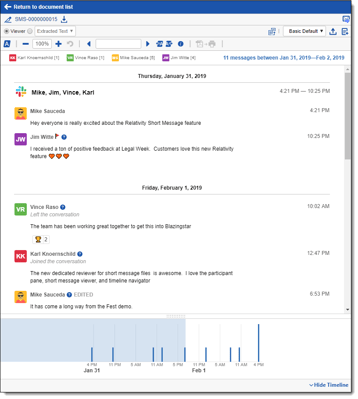
So now, instead of cumbersome spreadsheets, users can see short messages in an email-like format, and view photos, emojis, and other data that, before, required users to jump to other parts of the spreadsheet via hyperlinks. Users can also scroll down to see attachments, jpegs, etc., just as you would on a smart phone, then, click on those items and open them directly in the Viewer.
Other features and benefits of Relativity’s Short Message Viewer include:
- Timeline Navigator – allows you to locate exactly when something was said by participants
- Conversation Pane – displays a list of conversation participants, the number of messages they sent, and any available metadata about each participant, such as address and even physical characteristics
- Emoji Dashboard – see what emojis, emoticons, and avatars participants used – such as moneybags, thumbs up, angry face, and hundreds more
For a more in-depth look at Relativity Short Message Files, watch Relativity’s informative video:
“Long gone are the days where email and loose documents comprised most of the population that needed to be reviewed for discovery requests,” says Huter. “The need for mobile, instant messaging, and other collaborative applications has increased dramatically with more and more individuals working from home. Avalon Legal is already seeing requests to collect and review from these non-traditional sources and we’re happy to offer a solution, namely, RSMF, that’s seamless and easy to work with.”
There are even more exciting updates coming soon from Relativity. They recently acquired VerQu, which will allow them to process additional types of short message data in their native formats, for example, Teams. Another new development in the works is the ability to “cut” messages from a text conversation. Currently, texts are one long “document,” but Relativity is working on a process that will allow eDiscovery pros to cut and produce specific sections of a text message, rather than having to redact hundreds or even thousands of irrelevant messages surrounding that pertinent info. We’ll share more about these updates in future blogs, so stay tuned!
If you have questions about Relativity Short Message Format, or any other eDiscovery topic, contact Avalon today.